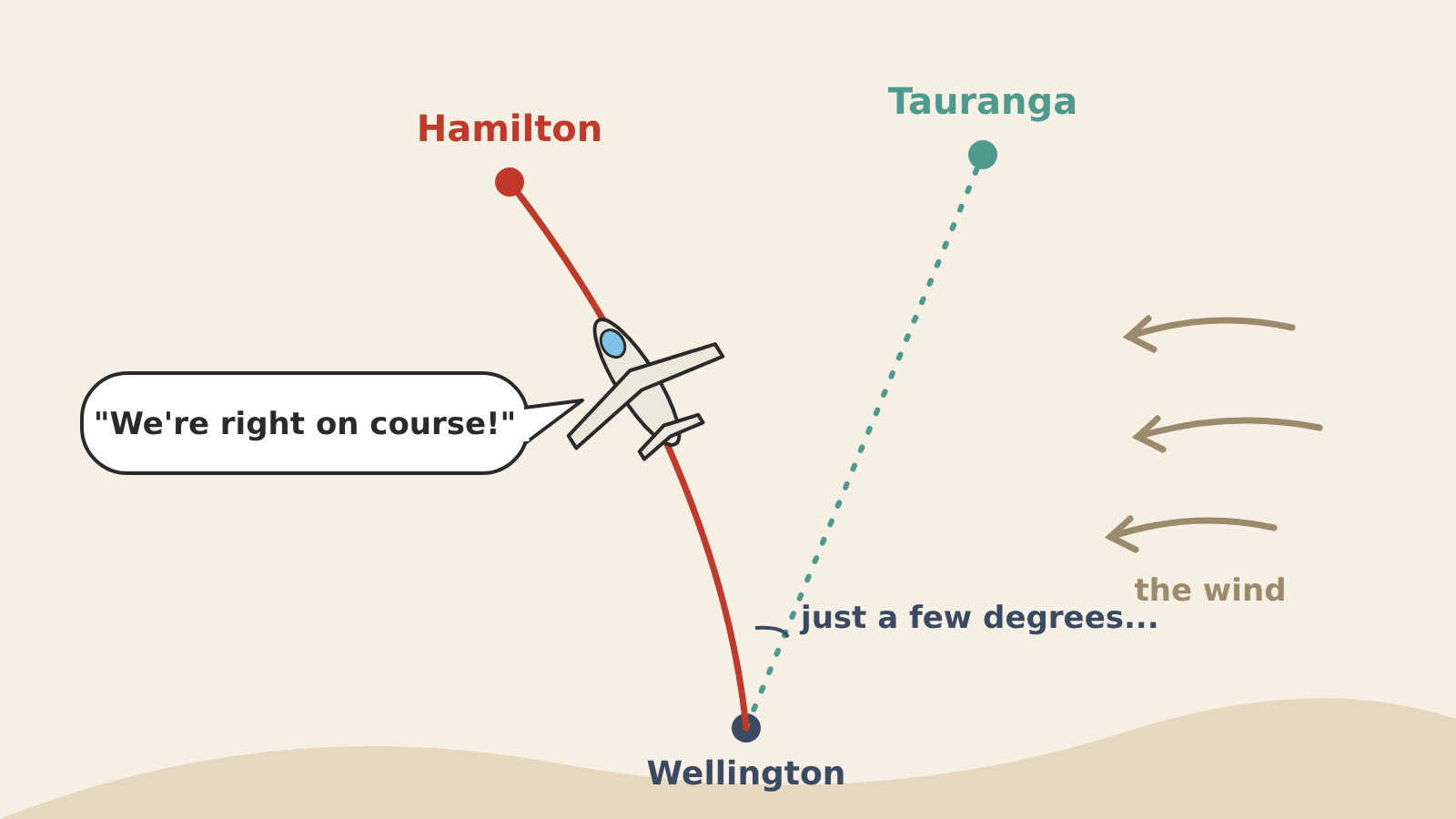
A mate of mine is learning to fly. He was telling me recently about something pilots call drift.
You set your heading, you hold it beautifully, and you still end up somewhere you never planned to be. Mostly it's the wind. It pushes you sideways a little at a time and the plane doesn't feel any different. You're flying straight. You're just not flying where you think you are.
Pilots have a rule of thumb for it, the 1 in 60 rule. One degree off and you'll be about a mile off track for every sixty miles you fly. Doesn't sound like much.
So I did the maths on a flight from Wellington to Tauranga. Just three degrees off and you've missed Tauranga by about 20 km. Ten degrees off and you land in Hamilton.
Nothing against Hamilton. Lovely place. Just not where you were going.
That's what I see in leadership teams. Nobody crashes. Nobody does anything dramatic. Everyone holds the heading they agreed at the strategy day... and a year later the business is somewhere nobody actually chose.
People often ask me why strategic plans fail. I've facilitated a lot of strategy days and leadership team offsites, and the day itself is rarely where it goes wrong. It goes wrong in the months after, a degree at a time. And with the world changing as fast as it is, the wind is a lot stronger than it used to be.
On paper my method has five steps: Shareholder Clarity, Strategy Alignment, Management Team Alignment, Plan, Action. In plain English it's three things, in order. Clarity, then alignment, then action.
Clarity... facing where you actually are
You can only steer from where you actually are. Not where the plan says you should be, or where you'd like to be.
Sounds obvious. It isn't. Put a leadership team in a room, ask where the business is right now, and you'll get as many answers as there are people. The finance person sees one business. The sales lead sees another. The owner sees a third... often the one that's been living in their head for the last couple of years.
They're working from different pictures of the same business. And no plan survives that.
Each of them is telling a story about the business. We all do it. It's how humans make sense of anything.
A researcher called Karl Weick spent years studying how people in organisations make sense of what's going on. One of his findings has stuck with me ever since: people favour a story that's plausible over one that's accurate.
Read that again. A story that sounds right beats a story that is right.
So the first job of a strategy day isn't the plan. It's getting everyone looking at the same reality, then agreeing one story about it that's actually true. The cash, the customers, the market, the people. Get the story wrong and the plan built on top of it will be wrong too, however good the slides look.
Alignment... holding the heading, and checking
A shared story drifts too.
You leave the day aligned. Everyone's on the same heading. Then real life starts. A big customer goes quiet, a key person leaves, the market shifts, someone reads the plan a little differently to everyone else. Three degrees here, two degrees there.
Pilots don't fix drift by gripping the controls harder. They keep checking where they actually are against the ground, and they correct. Little and often.
In a business that's a rhythm. I like 90-day cycles: plan, do, review, adjust, go again. And every year or so the leadership team comes back together. Not for a new strategy. The way I put it is, we left aligned, a year later we recalibrate... it's helping people get to grips with it now it's actually happening.
Living a plan feels very different from agreeing to one.
The catch is somebody has to say "I think we're off course" out loud. In a lot of teams that's the hardest sentence there is. It's where the elephants live... the thing everyone can see and nobody names.
One tool I use is a simple scale. Judgement at one end, acknowledgement at the other. Judgement leads to blame, and blame leads to fear. Acknowledgement leads to responsibility, and responsibility builds trust. A team of owners I worked with recently scored themselves a 4. They set a target of 7.5.
That's a team being honest about where it actually is. Which, funnily enough, is the first rule of navigation.
Action... which is really about inaction
When I say action, most people think of the plan. The project list, the owners, the dates.
In my experience the real problem is inaction. Teams don't drift because they did the wrong thing. They drift because nobody made the small correction while it was still cheap.
Why not? Usually fear. Fear of being judged for raising it, or of being wrong. Or waiting for a certainty that, in this world, isn't coming. We do the same thing to ourselves... judge ourselves, worry about it, and end up doing nothing at all.
And sometimes it's the leader. The one who quietly corrects everyone else's course for them. Picks up the monkey, rewrites the document over the weekend. It feels like help. But the team never learns to read the instruments, so the next time the wind picks up, they drift again.
So what do I actually look for after a strategy day? A team that checks its position, says what it sees, and makes the small correction early.
Three degrees caught early never becomes Hamilton.
How I run a strategy day
For anyone wondering what this looks like in practice, here's how I run one. (Short version. I'm dyslexic, I don't do 40-page reports!)
Before the day. I talk to each person one on one. I'm listening for the friction and tension in the business, because that's usually where things are going wrong. People often recognise an issue subconsciously well before they do intellectually. If there's more than one owner, we start with them. If the owners aren't on the same page, nobody else will be.
On the day. Live, in the room. We put the current picture of the business on the table, get the elephants out, and agree where we're actually going. Then we turn it into a plan people will act on.
After the day. A short written plan, not a doorstop. A 90-day rhythm to keep checking position. And about a year later I come back to recalibrate, because these days the picture drifts in months, not years.
I've been facilitating leadership teams since 2011, mostly owner-led businesses and their leadership teams. I'm based in Auckland and work across New Zealand and the Pacific. Fees are on my How I work page.
When did your team last check where it actually is?
Good luck out there. And don't forget to have fun!
Ben
Ben Marris is an advisor, coach and mentor to ambitious New Zealand CEOs, leaders and business owners. He has owned businesses and worked with business owners since the turn of the century. He gets leadership teams onto the same picture of where the business is going, then into a plan people actually act on. DM him and he'll set up a call, or have a look at marris.co.nz.
He loves red wine and a good story. He is also dyslexic, so if there are any spelling mistakes or grammatical errors blame his spell check, he does.